

This week, I would like to refer to a book that I borrowed from the Poetry Library in the Southbank Centre, (a wonderful place to visit).
‘A Ritual on How to Read Together-poems in conversation with William Stafford‘© is edited by Becca J.R. Lachman and published in 2013.
William Stafford was a prodigious and celebrated American poet, born in Hutchison, Kansas in 1914. I found him in a Poem a Day calender and liked his accessibility, simplicity and the straightforward way that he approached his writing. His poem, ‘Ask Me’ is one of my favourites, it speaks to the heart.
In the preface, the editor writes about how this anthology came about. She writes
’The first section responds to Stafford’s use of place, both as a location and as an individual’s purpose in a larger community. A second section considers the many layers of peacemaking and violence, within ourselves and in our world, while the final section dialogues with Stafford’s philosophies on the writing life and teaching writing.
I have chosen ‘Girl in the American Museum of Natural History’ © from this collection.
The next case shows how coral
is a bud producing rock, like a mouth
whose teeth are on the outside,
or a body within a bone.
It moves by growing.
The girl keeps her ear pressed to the glass display case,
listening for the clamor
inside each bustling skeleton.
She can see now her own voice
is a polyp and when she shouts
whole colonies of sound echo back.

-Laura Smyth ©
Remember ‘How to analyse a poem’ from last week’s creative corner?
Step 1: Subject. What is the poem about and why?
Step 2: Theme. What are the recurring ideas and topics?
Step 3: Tone. How would you describe the mood of the language?
Step 4: Imagery. What literary devices are used and what do they signify?
Step 5: Form. Why the poet has chosen this structure?
Step 6: Feeling. What are the different emotions being conveyed?
This is a 11 line poem with a single stanza, and three sentences. The form seems quite particular, with the longer sixth line allowing the poem to curve into two distinct halves, resembling a choral bud. The first half describes the coral behind the glass, the second allows the theme to grow to the girl itself. The poet makes clever use of assonance , with the repeated ‘o’s giving a sense of growth and expansion, as well as a pleasing musicality. Note the line breaks and end-words; coral, mouth, outside, bone, growing, case, clamor, skeleton, voice, shouts, back. Line them up together, and they spell out a tiny poem, (a tiny choral?)
Back to the form, and how it leans into the theme. What a wonderful description of choral, the vivid personification
‘mouth whose teeth are on the outside’
The poet then expands this theme to the second half of the poem, with
‘the clamor inside each bustling skeleton’
becoming a metaphor for the girl’s voice. Which, when she exercises it, is responded to by,
‘whole new colonies of sound’
For me, this is the heart of the poem, a perfect symbolism for the creative process. Surely, we as writers, artists, are the girl who
‘keeps her ear pressed to the glass display case’
watching and then sending out those same observations to other watchers, and listening for their voices in response.
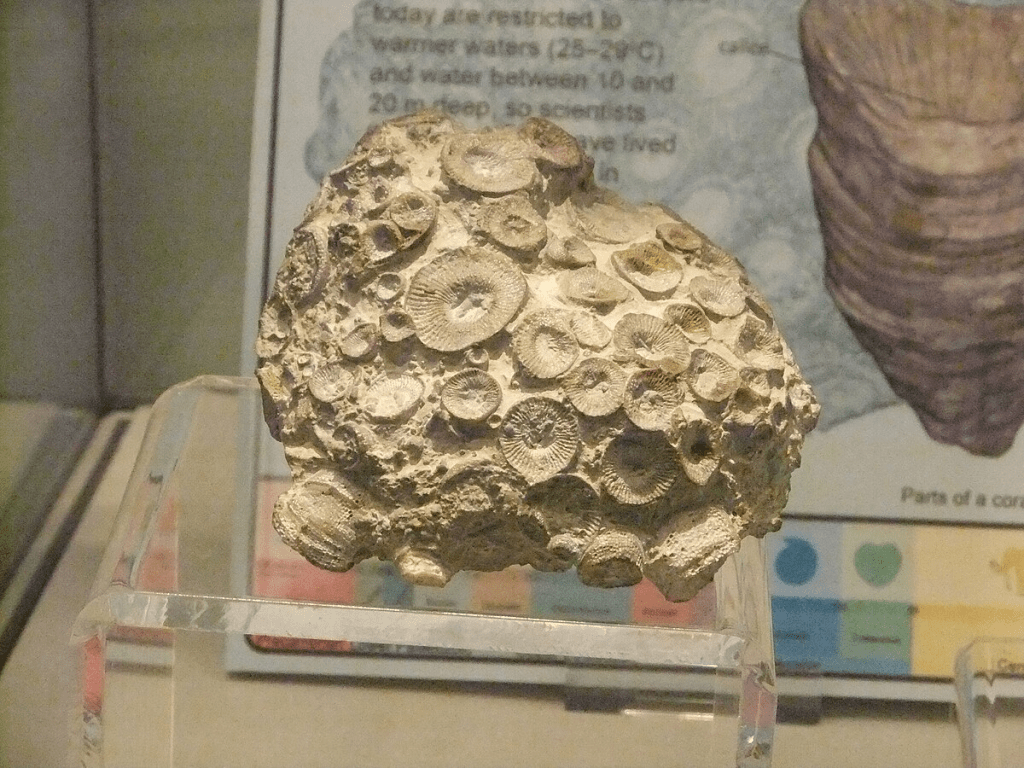
Silurian Anthozoa, Collections of Wrexham County Borough Museum, Wrexham photographs taken on 2013-05-14 Self-published work Photos uploaded by Rept0n1x ©
 Bonnie Braw Press